The No-Install AC: Cheap Niche at Home, Premium Hit Abroad
 By Jotham Lim
6 min read
By Jotham Lim
6 min read
Executive Summary#
Get the Full Report: Download the complete analysis for detailed data, methodology, and pages of insights.
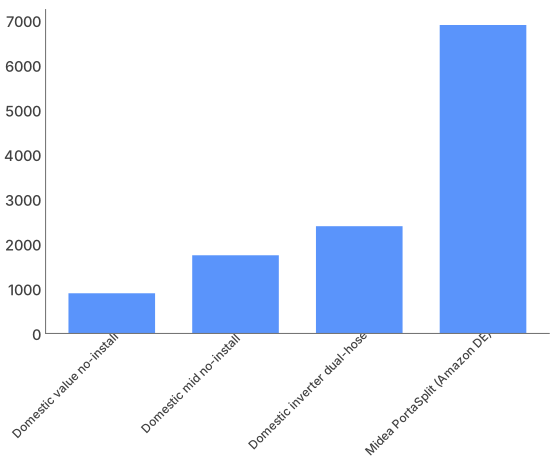
The no-install portable air conditioner is not a new idea in China — it is a small, low-priced, seasonal niche where domestic units sell for roughly CN¥ 899 to CN¥ 2,399. The same functional concept, engineered as Midea's PortaSplit, sells for roughly CN¥ 6,900 (about €899.99) as a premium hit on Amazon DE. The gap between those two prices is not a product breakthrough but a positioning one — and it reframes what "value" means for a movable-bracket AC abroad versus at home.
A Cheap Domestic Niche, Not a Frontier#
The no-install concept is old news at home, sold cheaply into a seasonal corner of a vast market. Domestic no-install portable AC is a modest category whose selling points read almost exactly like the PortaSplit's — no outdoor unit, no drainage, no installation, made for rentals and kitchens — yet the units sell for roughly CN¥ 800 to CN¥ 2,400. It is a rounding error beside the billions that move through household AC, where more than half of units sell below the low end of the price ladder. In other words, "no-install" at home is a budget convenience feature, not a premium proposition.
That framing matters because it tells you what a premium domestic version would actually be. The niche is led by value specialists, and Midea is already established as the No. 2 brand within it. A PortaSplit-grade domestic upgrade would therefore be an upgrade play from an existing position, not a greenfield entry — Midea would be climbing a price ladder it already stands on, not building one from scratch. The distinction changes the risk profile of the move entirely: the brand equity, the shelf presence and the category credibility are already there.
The clearest way to see the opportunity is to lay the domestic tiers beside the European price of the same form factor. Across the value, mid and inverter dual-hose tiers, domestic no-install units span roughly CN¥ 899 to CN¥ 2,399. The Midea PortaSplit, functionally the same idea, trades at roughly CN¥ 6,900 in Germany. The concept is identical; only the positioning and the price differ.
The same no-install concept sells for a fraction at home — the premium version is white space
Why the Premium Holds Abroad#
The premium survives the trip because the product is engineered to Europe's rules, not to a price point. Contrary to the popular "F-gas loophole" story, the PortaSplit does not win on an exotic refrigerant: it uses R32 at a 0.62 kg charge and runs at 39 dB in silent mode. R32 is an industry-standard refrigerant used across the category, so there is no chemical shortcut doing the work here. The real edge is architectural.
The form factor is what unlocks the price. The PortaSplit is a movable split whose outdoor element mounts on a bracket that hangs from a window or over a sill, delivering split-system cooling with no drilling and no façade alteration — precisely the changes that trigger permission requirements and professional-installer rules across much of Europe. Because nothing is bolted to the building, the unit stays below France's threshold for mandatory professional refrigerant-handling inspection, and its 39 dB silent mode fits within German residential night-noise limits. Each of those is a regulatory wall that a fixed split runs into and this product walks around.
Engineering to the rules is exactly why the same concept can command a fraction of the price at home and a premium abroad. In China, "no-install" solves a convenience problem in a market where three-quarters of homes already have cooling; the buyer will not pay much for it. In Europe, the identical form factor solves a legal and structural problem for people who otherwise cannot get cooling at all. Solving the harder problem is what the premium pays for.
Value Means Access, Not a Saved Install Bill#
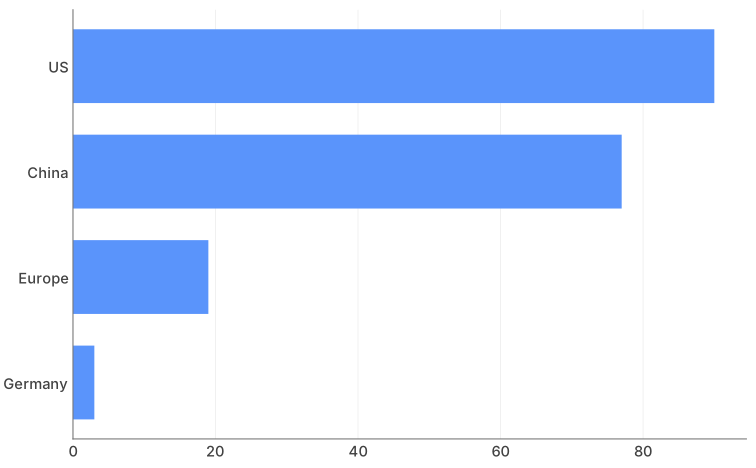
The most important reframe is what "value" means for this product: access for renters, not a saved installation bill. The European runway is structural — household air-conditioning penetration is only about 19% across Europe and roughly 3% in Germany, against roughly 77% in China and about 90% in the United States. A market this far below saturation, meeting more frequent extreme heat, has a demand runway that extends well beyond any single summer.
Europe's low air-conditioning penetration is the structural runway beneath the 2026 spike
Key Takeaways#
- The no-install AC is a small, low-priced, seasonal domestic niche, with units selling for roughly CN¥ 899 to CN¥ 2,399 across the value, mid and inverter dual-hose tiers.
- The same functional concept, as Midea's PortaSplit, sells for roughly CN¥ 6,900 (about €899.99) as a premium product on Amazon DE — a positioning gap, not a product breakthrough.
- Midea is already the No. 2 brand in the domestic niche, so a premium domestic upgrade would be an upgrade play from an existing position, not a greenfield entry.
- The premium holds because the product is engineered to Europe's rules — a movable-bracket, no-drill form factor (39 dB, R32 / 0.62 kg) that stays under France's inspection threshold and within German night-noise limits. It is not an "F-gas loophole" and not R290.
- Value here means access for renters: with penetration only about 19% in Europe and roughly 3% in Germany (versus roughly 77% China, about 90% US), a no-install unit reaches demand fixed splits legally cannot serve.
About the Data#
This analysis is based on Moojing Market Intelligence proprietary research across mainstream Chinese e-commerce platform activity (domestic no-install portable-AC prices and category structure) and Amazon DE marketplace analysis (the PortaSplit's European price). The Amazon data horizon is April 2026; the late-June 2026 sell-out peak is carried by dated third-party news citations. Product facts follow Midea UK/NL spec sheets (R32 * 0.62 kg * 39 dB, movable-bracket form factor); air-conditioning penetration figures follow WRI / IEA. Domestic figures are shown in CN¥ and the PortaSplit at its Amazon DE euro price (approximately CN¥ 6,900 at reference rates).
Download the Full Report#
Get the complete analysis — the domestic-market mirror, the four-market European breakdown, the Midea Group two-brand tables, and the regulation-aware product teardown behind the price gap.
More from This Report#
- How Midea won Germany: inside the PortaSplit sell-out — the pillar analysis.
- Inside Midea's home advantage: why a mature domestic leader globalises.
- Who really leads Europe's portable-AC boom.
This content adheres to Moojing's editorial standards .


