Sustainability in China's Beauty Market: What Consumers Actually Value
 By Jotham Lim
5 min read
By Jotham Lim
5 min read
Executive Summary#
Chinese beauty consumers care deeply about values that overlap with sustainability -- but they do not use the sustainability frame. Ingredient safety generates 1,170 social media posts versus just 33 for eco-packaging, a 35:1 ratio that reveals the fundamental disconnect between Western sustainability messaging and Chinese consumer priorities. Refills are the only commercially proven sustainable format, with 869 SKUs on Tmall led by Lancome at CN¥ 24.7M, yet they succeed as a luxury cost-saving strategy, not an environmental one. No brand has successfully claimed a consumer-facing sustainability position in China -- the competitive landscape is wide open.
Download Full Report#
Get the complete four-dimensional analysis spanning social media sentiment, e-commerce sales, 18 million+ consumer reviews, and competitive landscape mapping.
The Inverted Sustainability Pyramid: Self-Interest First, Planet Second#
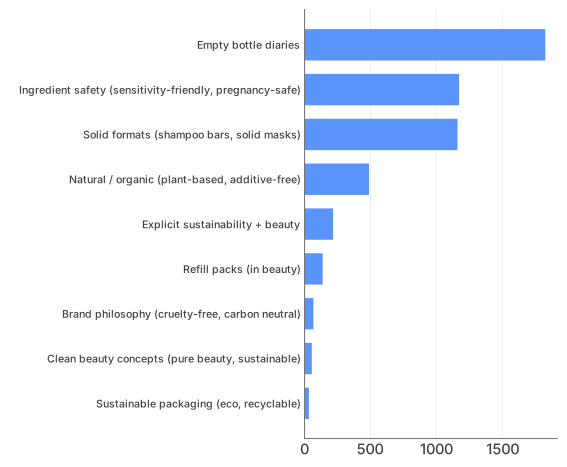
Cross-platform social media analysis across Xiaohongshu, Douyin, Weibo, and WeChat reveals a stark disconnect between what sustainability means in Western beauty markets and how Chinese consumers engage with overlapping values. Ingredient safety and solid formats generate thousands of posts; explicit sustainability and eco-packaging topics generate tens.
At the top of the volume pyramid: ingredient safety (1,170 posts) -- "Is this safe for my skin?" Natural ingredients (488 posts) -- "Is this chemical-free?" These personal-benefit topics generate 10-35 times more discussion than environmental topics at the bottom: cruelty-free (67) and eco-packaging (33). Consumers enter sustainability through self-interest first, planet second.
Ingredient safety outweighs eco-packaging discussion 35:1
Empty Bottle Diaries: China's Hidden Sustainability Behaviour#
Empty bottle diaries represent the largest single content format in the sustainability-adjacent space at 1,823 Xiaohongshu posts. This cultural behaviour encompasses:
- Consumption awareness -- tracking what you use to completion
- Anti-waste behaviour -- using products fully before repurchasing
- De facto product review format -- "what I finished" as social proof
This behaviour could be leveraged for sustainability messaging but is currently not connected to any environmental narrative at all. It represents a natural bridge between existing consumer behaviour and brand sustainability positioning -- one that no brand has yet exploited.
Refills: A Luxury Strategy, Not an Eco Strategy#
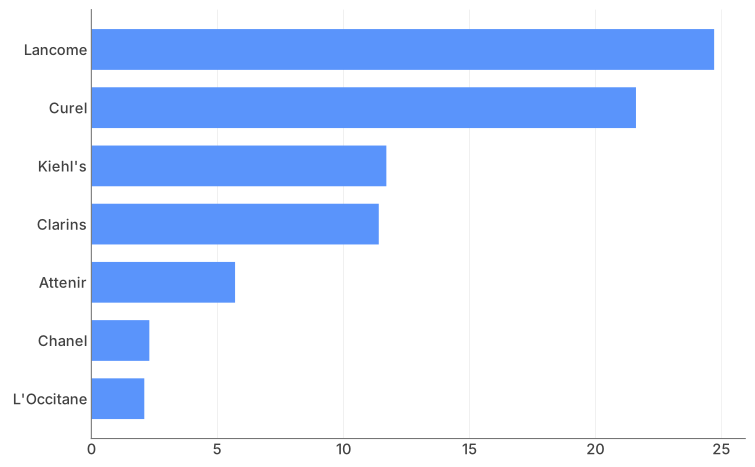
Tmall skincare category data (January 2025 to February 2026) confirms that refills are commercially proven -- but as a premium value proposition, not an environmental one. The category hosts 869 refill and supplement pack SKUs generating substantial revenue.
Consumer motivation centres on cost savings (buying a refill is cheaper than a new full unit) and premium ritual (the outer case becomes a keepsake -- La Prairie's gold case, Lancome's jar). Environmental concerns are not a driver. Only two brands actively use "eco" in refill product titles: Kiehl's and Attenir.
Lancome leads refill sales at CN¥ 24.7M — luxury drives, not eco
The Competitive Sustainability Landscape: No One Owns This Space#
No brand has successfully built a consumer-facing sustainability position in China's beauty market. The closest is Kiehl's with explicit "eco-pack" product naming. Lush is partially recognised for sustainability through its fun, handmade positioning. L'Oreal Group operates sustainability at a corporate level that does not translate to consumer-facing messaging.
The starkest contrast lies between two brands:
- Aesop: CN¥ 80M+ in Tmall sales, 514 social mentions -- loved for sensory qualities (scent, texture, aesthetic), with zero sustainability perception despite strong sustainability DNA
- The Body Shop: -22% YoY sales decline, only 50 social media mentions -- pure activist sustainability messaging that works in Western markets is actively undermining relevance in China
| Brand | Sustainability Strategy in China | Effectiveness |
|---|---|---|
| Kiehl's | "Eco-pack" product naming, refill format | Most explicit eco-positioning |
| Lush | Naked packaging, handmade, #NakedForThePlanet | Known for fun; sustainability partially recognised |
| L'Oreal Group | Refill formats across brands, LOHAS messaging | Corporate-level, not consumer-facing |
| Lancome | Premium refills, reusable cases | Positioned as luxury, not eco |
| Aesop | Minimal packaging, recyclable materials | NOT leveraged in China |
| The Body Shop | Community fair trade, against animal testing | Declining in China (-22% YoY) |
| Domestic brands | "Pure / Natural" positioning, ingredient-focused | Safety > Environment |
Source: Moojing CMI, public information
The product format opportunity is equally telling. Refills are rated HIGH opportunity (proven, growing, luxury-led). Solid formats rate MEDIUM (large for haircare via TCM positioning). Recyclable materials framing has VERY LOW traction -- zero product titles on Tmall use this framing.
Key Takeaways#
- Sustainability in China = ingredient safety first, planet second -- the 35:1 ratio between ingredient safety and eco-packaging discussion is the defining insight
- Empty bottle diaries (1,823 posts) are the largest sustainability-adjacent behaviour, representing an untapped bridge to eco-messaging that no brand has claimed
- Refills are commercially proven at 869 SKUs and CN¥ 24.7M (Lancome), but succeed as luxury value propositions, not environmental ones
- The Body Shop's -22% YoY decline is a clear warning: activist sustainability messaging does not work in China's beauty market
- Aesop's CN¥ 80M+ success with zero sustainability messaging proves that product excellence must precede eco-claims -- the sensory experience that consumers already value is the authentic sustainability story
- No brand has claimed a consumer-facing sustainability position -- the competitive landscape is wide open for the first mover who translates sustainability into Chinese consumer language
About the Data#
This analysis is based on Moojing Market Intelligence and Fusion API data covering China's beauty and skincare sustainability landscape from April 2025 to April 2026. Social media data spans Xiaohongshu, Douyin, Weibo, and WeChat via Fusion API. E-commerce data covers Tmall skincare category (January 2025 to February 2026), representing CN¥ 110.1 billion in total category sales across 601,000 items. Consumer review analysis draws on 18 million+ Tmall skincare reviews with aspect and sentiment analysis. For full methodology, competitive brand data, and strategic recommendations, download the complete report.
- Website: moojing-global.com
- Email: info@moojing-global.com
- LinkedIn: linkedin.com/company/68588397/
This content adheres to Moojing's editorial standards .


