18M Tmall Reviews Reveal Sustainability's Adoption Gap in Chinese Beauty
 By Jessie Wang
5 min read
By Jessie Wang
5 min read
Executive Summary#
Analysis of 18 million+ Tmall skincare reviews shows packaging and environmental considerations are completely absent from the top 10 purchase decision drivers -- yet consumers who try refills rate them 5.6:1 positive-to-negative. The gap is not satisfaction but adoption. In a CN¥ 110.1 billion skincare market, only 84 items carry "eco" labelling, while refills generate substantial luxury-led revenue. The Body Shop's -22% YoY decline versus Aesop's CN¥ 80M+ success without any sustainability messaging is the starkest proof: product excellence must precede eco-claims.
Download Full Report#
PLACEHOLDER:REPORT:china-beauty-sustainability-2026
The CN¥ 110 Billion Reality Check#
Tmall skincare category data (January 2025 to February 2026) reveals the commercial reality behind sustainability-adjacent product formats. The total category reached CN¥ 110.1 billion in sales across 708 million units and 601,000 items. Within this enormous market, sustainability-labelled products are nearly invisible.
Only 84 items on Tmall carry "eco" (环保) in their product titles. For context, refill and supplement pack formats account for 869 SKUs -- ten times the eco-labelled count -- and generate substantial revenue led by luxury brands. "Pure" labelled (纯净) products reach 430 items but are positioned around ingredient safety rather than environmental benefit.
The signal is clear: Chinese consumers are not searching for sustainability. They are searching for efficacy, value, and premium experience.
Refills: Luxury Strategy, Not Eco Strategy#
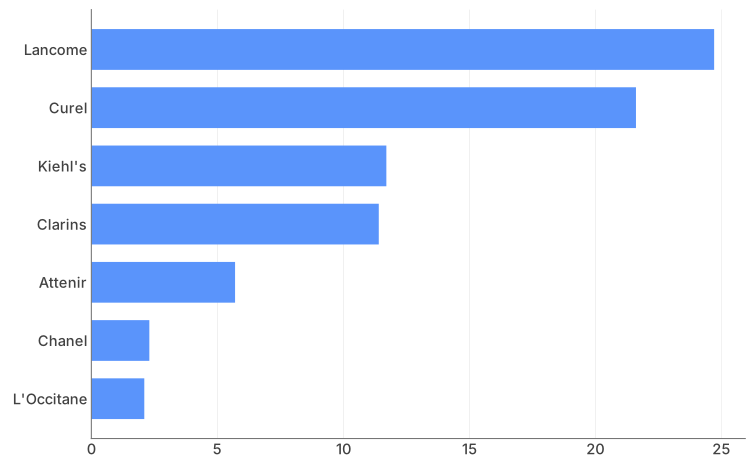
Refills in China are driven by cost savings (a refill is cheaper than a new full unit) and premium ritual (the outer case becomes a keepsake -- La Prairie's gold case, Lancome's jar). Environmental concerns are not a driver. Only two brands actively use "eco" in refill product titles: Kiehl's and Attenir.
Lancome leads refill sales at CN¥ 24.7M — luxury drives, not eco
What 18 Million Reviews Actually Say#
Analysis of 18M+ Tmall skincare reviews reveals the top 10 purchase decision drivers: category, skin type, function, usage scene, demographics, duration, texture, scent, size, and ingredients. Packaging is not in the top 10. Environmental considerations do not register as a purchase driver in Chinese skincare reviews.
When consumers do mention packaging format, the sentiment data tells a nuanced story:
| Format | Share of Mentions | Positive:Negative |
|---|---|---|
| Trial size | 39% | 4:1 |
| Full size | 33% | 3:1 |
| Individual wrap | 7% | 15:1 |
| Refill | 6% | 5.6:1 |
| Gift box | 3% | 10:1 |
Source: Moojing CMI (Tmall), 18M+ reviews
Individual wrap achieves the highest satisfaction ratio at 15:1 -- driven by hygiene and convenience perception, not sustainability. Refills score 5.6:1, well above trial size (4:1) and full size (3:1). Trial sizes dominate format discussion at 39% of mentions with a 4:1 ratio, reflecting Chinese consumers' preference for trying before committing.
The paradox is stark: consumers who try refills love them, but only 6% of format mentions reference refills at all. The challenge is not convincing consumers that refills are good -- it is getting them to try refills in the first place.
Two Brands, Two Lessons#
The most instructive comparison in the data is between Aesop and The Body Shop -- two brands with strong sustainability DNA but radically different outcomes in China.
Aesop holds 574 items on Tmall and generates CN¥ 80M+ in sales. Its sustainability story -- minimal packaging, recyclable materials -- is completely invisible to Chinese consumers. The brand is loved for sensory qualities: scent, texture, aesthetic. Sustainability is embedded in the product experience but never communicated as such. And it works.
The Body Shop has 105 items, generates only CN¥ 7.3M, and is declining at -22% YoY. Its activist sustainability positioning -- community fair trade, against animal testing -- which resonates strongly in Western markets actively undermines brand relevance in China. Only 50 social media mentions confirm the brand's near-invisibility.
The lesson: product excellence creates the market position; sustainability messaging, when applied without product-first credibility, accelerates decline.
Strategic Implications: Translating the Language#
Sustainability must be linguistically translated into Chinese consumer language. The data suggests specific translations:
- "Sustainability" becomes ingredient safety (成分安全) and gentle and natural (温和天然)
- "Eco-packaging" becomes refill (value framing) and premium packaging (精致包装)
- "Carbon neutral" is not yet consumer-relevant in Chinese beauty
Brands that lead with Western sustainability framing will face The Body Shop's fate: declining relevance in a market that does not respond to activist environmental messaging. The refill format has proven product-market fit -- 869 SKUs, CN¥ 24.7M at the top, and 5.6:1 consumer satisfaction. The opportunity lies in brands well-positioned in premium skincare that have not yet introduced refill formats in China.
Shampoo bars present a separate opportunity: 773 items on Tmall positioned as Traditional Chinese Medicine remedies (cypress leaf for anti-hair-loss, polygonum for anti-grey-hair) with zero mention of plastic reduction. The eco-narrative is entirely absent from this large category. Repositioning solid formats as "artisanal natural" rather than "eco" could tap into the existing TCM hobbyist community.
Key Takeaways#
- Packaging is absent from the top 10 purchase drivers across 18M+ Tmall skincare reviews
- Refills score 5.6:1 satisfaction but account for only 6% of format mentions -- the gap is adoption, not quality
- CN¥ 24.7M in Lancome refill sales proves refills work as luxury positioning, not eco positioning
- Only 84 "eco" labelled items exist in a 601,000-item Tmall skincare market
- Aesop's CN¥ 80M+ without sustainability messaging vs The Body Shop's -22% YoY with it settles the debate
- Sustainability language must be translated: ingredient safety and premium value, not environmental activism
More from This Report#
About the Data#
This analysis draws on Moojing CMI data covering Tmall skincare (January 2025 to February 2026), including 18 million+ consumer reviews, and social media tracking across Xiaohongshu, Douyin, Weibo, and WeChat via Fusion API. For full methodology, brand-level data, and additional competitive analysis, see the complete China Beauty Sustainability whitepaper.
This content adheres to Moojing's editorial standards .


