China's Desktop Cooking Market Polarizes Around Health
 By Jotham Lim
4 min read
By Jotham Lim
4 min read
Executive Summary#
China's desktop cooking appliance market polarized in 2022 on two leading Chinese marketplaces. Sales of air fryers grew 52.5% YoY, electric steamers 61.2% and electric grills 16.4%, while electric ovens, electric fondue pots and multifunctional cooking pots came under pressure[1]. Products that offer health benefits or suit social dining took a growing share of spending, while traditional categories faced saturation and competition from substitutes. This analysis looks at the forces behind this divide and at what it means for brands choosing which categories to enter.
Download Full Report#
Get the complete analysis with additional data, methodology details, and brand-level insights across all eight desktop cooking appliance categories.
Download the Full Q1 2023 Desktop Cooking Appliances Whitepaper →
A Market Reorganising Around New Priorities#
Sales of desktop cooking appliances on the two marketplaces exceeded CN¥ 12.28 billion in Gross Merchandise Value (GMV) in 2022, and air fryers were the largest category, with CN¥ 4.79 billion in sales. The total hides a sharp divergence, since three of the eight categories grew while the other five came under pressure, which shows a market reorganising itself around new consumer priorities.
The Categories That Grew: Health and Social Dining#
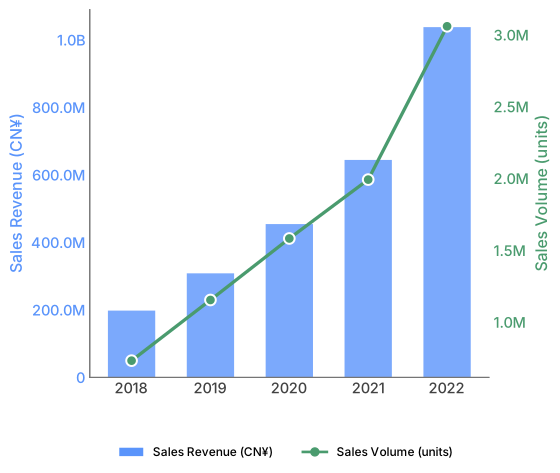
Electric steamers grew fastest, with sales up 61.2% YoY to CN¥ 1.04 billion. The category has grown for five consecutive years, from CN¥ 198 million in 2018 to CN¥ 1.04 billion in 2022. Steaming holds a special place in Chinese cooking, where it is seen as one of the healthiest ways to prepare food. The electric steamer has modernised the tradition with automatic timing, several layers of capacity and compact designs that fit on a countertop.
Electric steamers deliver five consecutive years of growth, accelerating to +61.2% in 2022
The Categories Under Pressure: Normalisation After the Pandemic and Substitution#
Electric ovens came under pressure after their sales peaked in 2020, as consumers moved to compact alternatives such as air fryers. Electric hot pots, whose sales peaked in 2021, came under pressure in 2022 as demand returned to normal after the pandemic.
What Determines a Category's Trajectory#
We believe the divide points to a simple framework for judging which desktop cooking categories will succeed, in which a product needs to benefit from at least one of two lasting trends:
- Health positioning: Categories marketed on "oil-free", "fat-reducing" or nutrient-preserving benefits, such as air fryers and steamers, attracted spending from health-conscious consumers
- Social dining appeal: Products used at the table in shared settings, such as grills and, while they were growing, hot pots, benefited from China's communal dining culture
- Both combined: Air fryers succeeded most because they delivered health benefits in a cooking format that is social and easy to share, which social media then amplified
Categories that relied only on functional convenience, such as electric ovens for baking and pancake makers for breakfast, came under pressure as the market matured beyond basic utility.
Key Takeaways#
- China's desktop cooking market polarized in 2022, as three categories grew while the other five came under pressure
- Electric steamers grew fastest, with sales up 61.2% YoY to CN¥ 1.04 billion and five consecutive years of growth
- Electric ovens came under pressure after their 2020 peak, as consumers turned to air fryers in their place
- Electric grills grew in each of the five years, in step with the rise of social dining culture
- Success in the category in 2022 required deliberate positioning around health benefits, social dining or, ideally, both
About the Data#
This analysis draws on Moojing Market Intelligence data covering the 2018-2022 period. The sales figures come from two leading Chinese marketplaces. For full methodology and additional insights, see the complete Desktop Cooking Appliances whitepaper.
This content adheres to Moojing's editorial standards .


