Social Dining Culture Reshapes China's Cooking Appliance Demand
 By Jessie Wang
4 min read
By Jessie Wang
4 min read
Executive Summary#
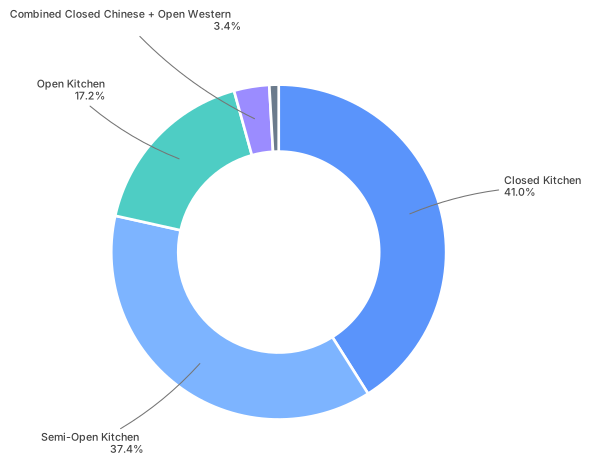
By 2022, open and semi-open kitchens accounted for more than 54% of Chinese households[1], fundamentally shifting cooking from an isolated kitchen task to a shared tabletop social activity. Combined with 46.9% of consumers gathering for holiday dining and over 70% of post-1990s consumers identifying as "non-cooking types," these behavioral and architectural shifts drove demand for desktop cooking appliances with strong social and convenience attributes. This analysis examines how social dining culture, the "lazy economy," and the emotional value of kitchen appliances reshaped China's desktop cooking market between 2020 and 2022.
Download Full Report#
Get the complete analysis with additional data, methodology details, and brand-level insights across all eight desktop cooking appliance categories.
Download the Full Q1 2023 Desktop Cooking Appliances Whitepaper →
From Kitchen Cooking to Tabletop Cooking#
The evolution of Chinese kitchen design provided the physical infrastructure for desktop cooking appliance adoption. Semi-open kitchens account for 37.4% of households and open kitchens for 17.2%, which creates spaces where cooking can be shared by everyone at the table. This architectural shift converges with strong consumer demand for communal dining experiences.
Semi-open kitchens account for 37.4% of Chinese households, which supports tabletop cooking
Holiday Gatherings Drive Social Cooking Demand#
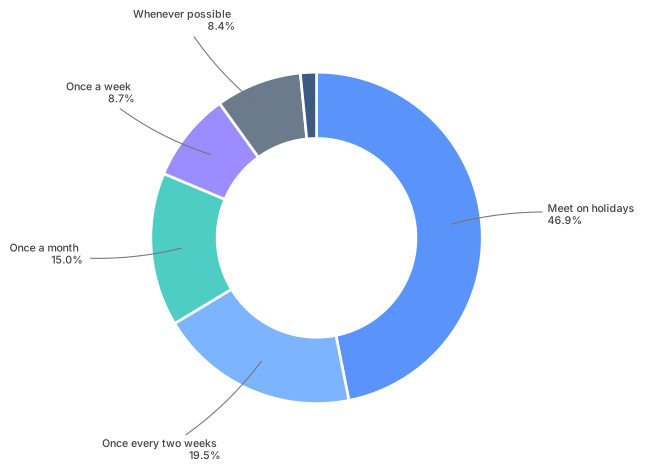
The gathering frequency data confirms that holiday-driven socializing anchors communal dining demand. Nearly half of Chinese consumers (46.9%) gather with friends and family at holiday periods, with hot pot, barbecue, and pizza emerging as preferred social dining formats.
Nearly half of Chinese consumers gather at holiday nodes, driving social cooking appliance demand
The Lazy Economy and Light Cooking#
The convergence of pandemic-era behavioral changes and the established "lazy economy" transformed desktop cooking appliance demand. Over 70% of post-1990s generation consumers identify as "non-cooking" types, preferring minimal-effort meal preparation. This large group of young urban professionals, who have limited cooking skills but a growing interest in dining at home, created the demand conditions for "light cooking" appliances.
Air fryers exemplify the response to this trend: users report that they require minimal preparation (no oil, no preheating) and deliver consistent results regardless of cooking experience. According to Moojing Market Intelligence (魔镜洞察) data, 42.6% of consumers cited "liberation of hands through multifunctional features" as their primary purchase motivation, confirming that automation and simplicity drive the market more than culinary sophistication.
The emphasis on convenience aligns with broader consumer preferences. Survey data shows 54.5% of consumers identified "convenient operation and time savings" as the primary benefit of kitchen small appliances, while 46.2% valued the "collection of functions" that reduce kitchen clutter.
Kitchen Appliances as Happiness Products#
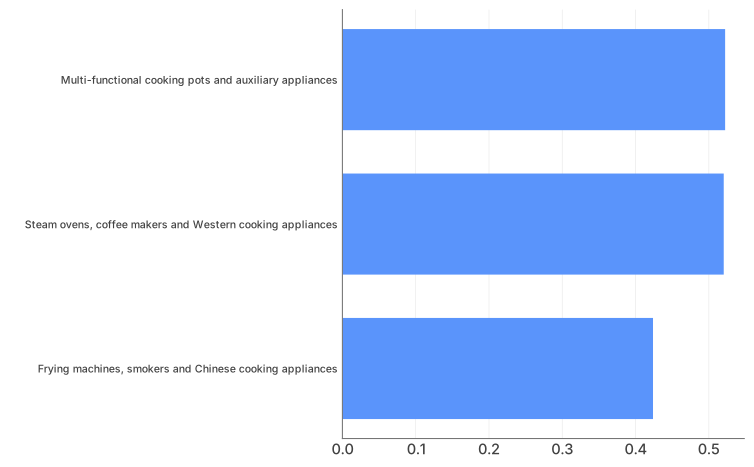
Multifunctional cooking pots narrowly lead as the top happiness-boosting kitchen appliance
Implications for Product Positioning#
The consumer trend data reveals a clear framework for brand strategy in desktop cooking appliances:
- Social scenarios over solitary utility: Products that enable participatory, tabletop cooking experiences (grills, hot pots, air fryers) captured the strongest growth, while single-purpose, kitchen-counter appliances (ovens, pancake makers) contracted
- Convenience as a baseline: Consumers expect minimal preparation, easy cleaning, and automated cooking programs as standard features, not premium differentiators
- Emotional connection matters: Kitchen appliances serve as "happiness-enhancing lifestyle products" for young urban consumers, creating opportunities for brands that market around emotional benefits rather than functional specifications alone
- Renter-friendly design: Products suited to small urban apartments with limited kitchen space address the needs of 240 million potential consumers
Key Takeaways#
- Open and semi-open kitchens in 54.7% of Chinese households created the physical infrastructure for tabletop cooking appliance adoption
- Holiday gatherings (46.9% of consumers) represent the primary social dining occasion, but regular gatherers (43.2% combined) sustain year-round demand
- Over 70% of post-1990s consumers identify as "non-cooking types," driving demand for automated, low-skill "light cooking" appliances
- 52.2% of consumers view multifunctional cooking pots as happiness-enhancing products, elevating desktop appliances beyond functional tools to lifestyle items
- Products positioned around shared, participatory cooking grew faster than solitary-use alternatives in several desktop cooking categories
More from This Report#
## About the Data
This analysis draws on Moojing Market Intelligence data covering the 2018-2022 period. Moojing analyses brand and category performance across major Chinese e-commerce platforms. For full methodology and additional insights, see the complete Desktop Cooking Appliances whitepaper.
This content adheres to Moojing's editorial standards .


