China's Disposable Underwear: Travel and Hygiene Lift Demand
 By Jessie Wang
6 min read
Newer data: China Maternity Prep Supplies Grew 12.7% Online in H1 2026
Executive Summary#
Sales of disposable underwear on two leading Chinese marketplaces reached CN¥ 1.16 billion from January to August 2024, a gain of 8.1% year-on-year, while demand for disposable products as a whole came under pressure. Social media discussion more than doubled, growing 117.3% YoY to 1.01 million posts, driven by a viral debate over hygiene standards in July 2024 that brought the category into the national conversation. Competition among brands is fragmented, and the budget segment below CN¥ 20 grew its share of volume from 18.6% to 33.6% in two years. Sizing problems account for 33.2% of all negative consumer feedback, which we believe makes fit the clearest opportunity for product improvement in the category.
A Market That Grew Against the Category Trend#
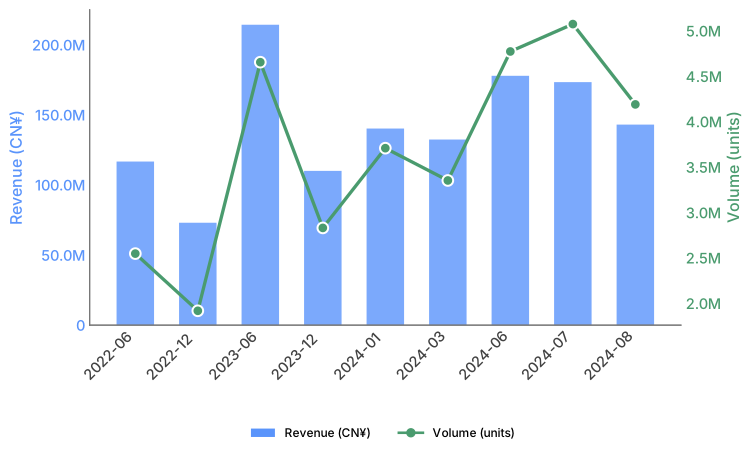
While demand for disposable consumer products as a whole came under pressure in January to August 2024, sales of disposable underwear grew a steady 8.1% to CN¥ 1.16 billion. Volume grew considerably faster than sales: July 2024 recorded 5.07 million units sold, 2.5 times the July 2022 level of 2.0 million units, which shows that lower average selling prices are bringing new groups of consumers into the category.
Monthly sales followed a clear seasonal pattern, with June reaching CN¥ 178 million, the highest of 2024, as summer travel demand peaked. Every month from January to August 2024 was well ahead of the same month in 2022, and we believe this points to a lasting growth in demand more than a temporary spike.
Disposable underwear reaches CN¥ 1.16B in Jan-Aug 2024, up 8.1% YoY with accelerating volume growth
Social Media: Discussion Grew 117.3%#
On social media, disposable underwear moved against the wider disposable products market, where overall engagement fell 44.4%. Monthly discussion volume ranged from 73,000 to 186,000 posts in 2024, and July set a record at 186,304 posts. Two viral events drove that peak, a marketing campaign by MINISO that linked disposable underwear to preparing for travel in Xinjiang, and a heated public debate about hygiene and safety standards in the manufacture of disposable underwear.
Engagement tells a similar story. July 2024 engagement reached 3.77 million interactions, equal to the previous record. While engagement across the wider category tired, content about disposable underwear continued to draw genuine interaction from consumers, in the form of product reviews, shared experiences and debates about quality. That gives brands willing to provide credible and informative content a natural marketing opportunity.
Price Migration: The Rise of the Budget Segment#
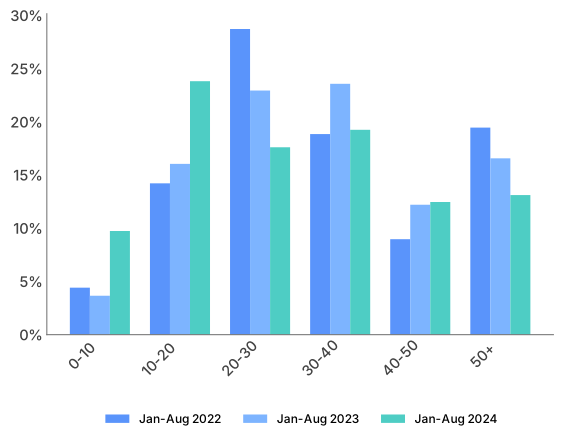
The shift in the distribution of price tiers over three years is the most important strategic finding in this market. The sub-CN¥ 10 tier more than doubled its share of volume, from 4.4% in 2022 to 9.7% in 2024, while the CN¥ 10-20 tier grew from 14.2% to 23.8%. Together, the segment below CN¥ 20 accounted for 33.6% of total volume in 2024, up from 18.6% in 2022, a gain of 15 percentage points.
The budget segment grew mainly at the expense of the CN¥ 20-30 tier, whose share fell from 28.7%, the largest single tier in 2022, to 17.6%. Every tier above CN¥ 50 lost share of volume steadily, and the premium bulk tier above CN¥ 100 moved from 5.4% to 4.0%.
Sub-CN¥ 10 tier more than doubles its volume share from 4.4% to 9.7% in two years, as the budget segment grows
Brands: A Fragmented Market#
Brands in the category serve clearly different price segments, from premium maternity products to budget value packs:
- Emxee (嫚熙): premium maternity positioning, at an average price of CN¥ 86
- Badi Gao (巴迪高): a mid-range focus on quality, at CN¥ 41
- Qihaixiu (七海秋): budget value pricing, at CN¥ 17
- Purcotton (全棉时代): a heritage in cotton textiles, at CN¥ 53, in the quality mid-premium segment
Concentration among the largest brands is low, which we believe shows that brand loyalty offers little protection. Switching costs are low and buyers are sensitive to price, so new entrants that price aggressively can gain ground quickly. The most instructive pattern is that EO sterilisation and 5A/7A antibacterial certifications have become basic requirements, as most of the best-selling products feature these credentials prominently.
What Consumers Say: Sizing Is the Biggest Problem#
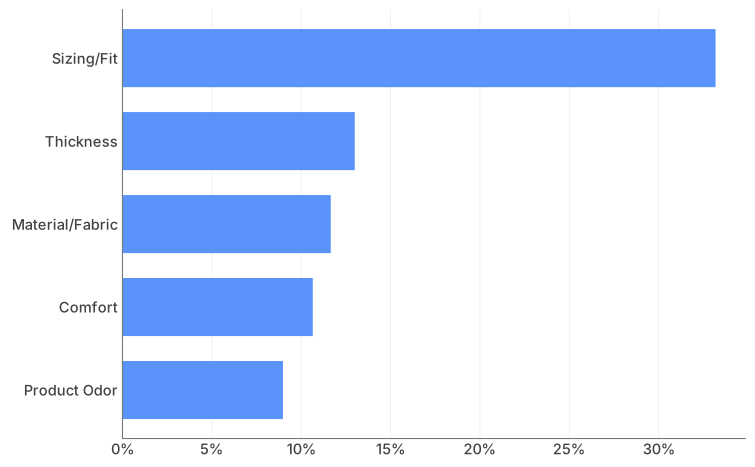
Analysis of negative consumer feedback shows that sizing and fit problems account for 33.2% of all complaints, the largest single pain point by a wide margin. Common complaints include "runs small even in larger sizes," "no elasticity," and "constricting leg holes." The problem comes from the product itself, since lightweight cotton and non-woven fabrics offer less stretch than traditional elastic underwear.
Beyond fit, consumers care most about breathability, which accounts for 12.6% of comfort discussion and grew 90.6% YoY, and about softness and gentleness on the skin. The general "comfortable" sentiment is the fastest-growing attribute, up 157.9% year-on-year, which shows that consumer expectations are moving quickly from "good enough for disposable" toward the comfort standards of regular underwear.
Travel and vacation scenarios account for the largest share of use-case discussion, at 19.8% of voice, followed by business travel (11.0%) and postpartum care (6.8%). The fastest growth comes from outdoor hiking, up 494.7% YoY, which signals new demand from outdoor enthusiasts who value the low weight and convenience of disposable underwear on multi-day trips.
Sizing issues account for 33.2% of negative feedback, making fit optimization the top product improvement priority
Strategic Implications#
- For brand builders: the price tier below CN¥ 20 is where volume is growing, while we believe the CN¥ 40-50 tier offers the best combination of growth and margin. Brands should choose their position clearly, since the CN¥ 20-30 tier in the middle is where share of volume has fallen.
- For product developers: sizing is the biggest opportunity. Better elastic, wider size ranges and more accurate sizing guidance would reduce the 33.2% share of negative feedback and encourage repeat purchases.
- For marketers: discovery is concentrated, with one content platform carrying 70.1% of the social media conversation. Travel-scenario content, packing tutorials and hygiene education are where to invest, and the 117.3% growth in social media discussion shows that consumers are looking for information, so brands that become a credible source of it stand to gain.
- For new entrants: the children's segment, where HeyBetter sells at CN¥ 8.8 per piece, carries premium prices and is an under-penetrated niche. EO sterilisation and antibacterial certification are basic requirements.
About the Data#
This analysis is based on Moojing Market Intelligence data from two leading Chinese marketplaces, together with social media analysis across major Chinese social platforms. Data covers January 2022 to August 2024.
Download the Full Report#
Download the full China Disposable Consumer Products Q3 2024 report
More from This Report#
This content adheres to Moojing's editorial standards .
Frequently Asked Questions
Because it has a use case the rest of the category lost. Sales on two leading marketplaces reached CN¥ 1.16 billion between January and August 2024, up 8.1%, while demand across the broader disposable consumer products category came under pressure. Volume tells the fuller story: July 2024 recorded 5.07 million units, two and a half times the 2.0 million of July 2022. Falling average prices are bringing new consumer cohorts in rather than cannibalising existing ones. The seasonal shape confirms the driver: June peaked at CN¥ 178 million as summer travel demand built, and every month outperformed its 2022 equivalent by a wide margin.
The budget end grew and the middle gave way. The sub-CN¥ 10 tier more than doubled its volume share from 4.4% in 2022 to 9.7% in 2024, and the CN¥ 10-20 tier expanded from 14.2% to 23.8%. Together they took the under-CN¥ 20 segment from 18.6% to 33.6%, a 15 percentage point gain in two years. That came almost entirely at the expense of the CN¥ 20-30 tier, which fell from 28.7%, the single largest tier in 2022, to 17.6%. Every tier above CN¥ 50 lost share too, with the bulk premium tier moving from 5.4% to 4.0%. The lesson for brands is to choose a clear price position, since the middle of the market is where share of volume has fallen.
Sizing, by a wide margin. Fit issues account for 33.2% of all negative consumer feedback, the single largest pain point in the category, with complaints clustering on running small even in larger sizes, no elasticity, and constricting leg holes. The problem is inherent to the format, since lightweight cotton and non-woven fabrics offer less stretch than elastic underwear, which is precisely why solving it would be defensible. Beyond fit, breathability accounts for 12.6% of comfort discussion and grew 90.6%, and the general "comfortable" sentiment is the fastest-growing attribute at +157.9%, as expectations migrate from "good enough for disposable" toward regular underwear standards.
Travel first, outdoor next. Travel and vacation scenarios dominate use-case discussion at 19.8% of voice, followed by business travel at 11.0% and postpartum care at 6.8%. The fastest-growing scenario by far is outdoor hiking at +494.7%, signalling emerging demand from people who value the weight and convenience benefits on multi-day trips, a segment that barely existed in the category's original framing. Discovery is heavily concentrated, with one content platform carrying 70.1% of the conversation, so travel-scenario content, packing tutorials and hygiene education are where the +117.3% growth in discussion can be converted. By 2024, sterilisation and antibacterial certification were table stakes rather than differentiators.


