Volume Leads Growth in China's Online Household Paper Market
 By Jessie Wang
6 min read
By Jessie Wang
6 min read
Executive Summary#
China's online household paper products market is in a period of volume-driven growth amid intensifying competition, with facial tissue accounting for 47% of the market at CN¥ 20.35 billion in Jan-Oct 2024 (+16.0% YoY). Moisturizing tissue is the fastest-growing segment at +24.5%, while demand spreads across a widening mix of replenishment-led and discovery-led sales channels. This analysis examines category dynamics, concentration by format, and the channel strategies that are changing China's household paper market.
Download Full Report#
Get the complete analysis with category-level detail, pricing trends, consumer sentiment data, and social media marketing strategies.
Download the Full December 2024 Household Paper Products Whitepaper -->
Volume Growth Offsets Price Pressure#
China's online household paper products market shows consumer adoption expanding while competition intensifies. Monthly order volumes in 2024 ran ahead of 2023 in every checkpoint month shown, with October 2024 reaching 244.6 million units against 167.6 million in October 2023[1], an increase of 45.9%. That expansion has come with a broader spread of price points across commodity formats, so the category's growth is being led by the number of units bought more than by the price paid.
The market's seasonality remains pronounced, with the June 618 Festival and November Singles' Day concentrating demand into short promotional windows. A structural shift in 2024 was that Singles' Day pre-sales were captured earlier, in October, which made October 2024 the strongest month outside November in the Jan-Oct windows the data covers[1].
Household paper order volumes rose year-on-year in every checkpoint month
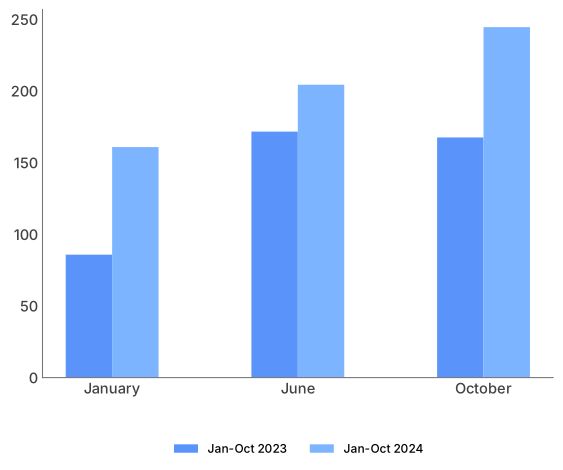
The divergence between volume growth and the direction of prices indicates that the market is widening its consumer base through accessible pricing. This pattern typically comes before a category matures and then premiumizes, a cycle already visible in the rapid growth of moisturizing tissue.
Channel Dynamics: Discovery Diversifies Beyond Search#
The balance among China's online sales channels is shifting, and no single channel model carries the category on its own. Household paper is bulky, low-priced and bought repeatedly, so much of the demand is planned replenishment, where the shopper already knows the format and buys in bulk, and channels built around dense fulfilment and value pricing serve that behaviour well.
Discovery-led commerce does a different job. Premium and differentiated formats such as moisturizing tissue depend on demand that has to be created, since shoppers rarely search for them by name. KOC (Key Opinion Consumer) demonstrations of softness, ingredient claims and pack formats are how such products are introduced. In 2024, household paper demand spanned both the replenishment-driven and the content-driven sides of Chinese e-commerce, and the two reward different things.
In practice, this means fulfilment economics and content production can no longer be budgeted separately. The same SKU needs a bulk-value proposition in one kind of channel and a product story that can be demonstrated in the other. Because no single channel model accounts for the category on its own, we believe omnichannel coverage has become a basic requirement for brands in household paper.
Category Landscape: Premiumization Meets Diversification#
The nine major categories divide clearly into mature and growth segments. Facial tissue is the largest category at CN¥ 20.35 billion (+16.0% YoY), while moisturizing tissue has the highest growth at +24.5%[1]. Kitchen paper towels (+19.4%) and kitchen wet wipes (+17.0%) represent emerging usage occasions that are gaining traction as Chinese households adopt more diverse cleaning practices.
Facial tissue leads at CN¥ 20.35 billion while moisturizing tissue grows fastest at +24.5%
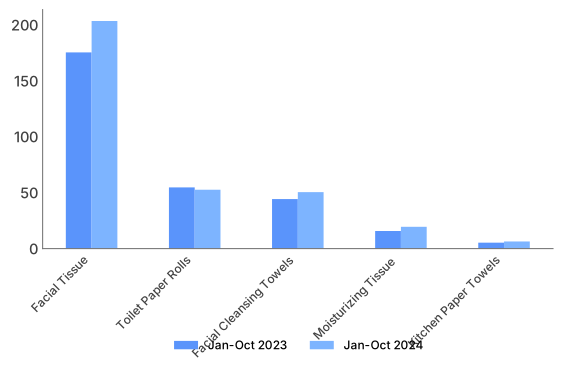
The softer categories matter as well. Changes of -3.8% in toilet paper rolls and -7.3% in standard wet wipes suggest that consumers are moving towards higher-value alternatives. We believe this pattern, in which differentiated products grow at the expense of commodity ones, shows a maturing market where functional claims and ingredient stories increasingly decide which products win.
Concentration Varies Dramatically by Format#
Concentration differs sharply from one format to another. Moisturizing tissue and pocket tissue are consolidated segments, where a small number of players account for most of the volume and the buying decision is largely made before the shopper reaches the shelf. Standard wet wipes, kitchen wet wipes and facial cleansing towels sit at the other end, where no durable leader has emerged and share moves with each product cycle.
What separates the two ends is mainly the product claim. In the consolidated formats the early movers set the category's reference points, such as softness, the ingredient story and pack size, and later entrants have to argue against a standard someone else defined. Breadth across several formats gives a brand shelf presence and fulfilment efficiency, while depth within one format lets it define what a good product in that format is.
In the fragmented formats no such standard exists yet, which is why they are the most accessible entry points for new brands. Differentiation through ingredients, materials or usage positioning can build share quickly there, because there is no established definition to displace first.
Strategic Implications#
Three strategic themes emerge from this analysis. First, volume-led growth through accessible pricing is expanding the overall market, creating opportunities for brands that can balance cost efficiency with product quality. Second, channel diversification calls for omnichannel strategies, with content-led discovery becoming increasingly important for trial in differentiated formats. Third, premiumization in niche segments, particularly moisturizing tissue, kitchen paper and flushable wet wipes, rewards brands that invest in functional differentiation and ingredient innovation.
For international brands and new market entrants, price competition in the commodity segments and premium growth in the specialty categories together create two opportunities. They can compete on volume in the core categories while building brand equity through innovation in the high-growth segments.
Footnotes#
[1] Source: Moojing Market Intelligence, Jan-Oct 2024 e-commerce sales analysis covering leading online marketplaces in China.
This content adheres to Moojing's editorial standards .
Frequently Asked Questions
Volume-driven, against falling prices. Monthly volumes in 2024 consistently exceeded 2023 levels: October 2024 reached 244.6 million units against 167.6 million a year earlier, a +45.9% increase. Average selling prices moved down at the same time, producing modest but positive revenue growth overall. That combination expands consumer adoption and compresses margin at the same time, so the categories to be in are those where a functional claim can hold price. Seasonality is pronounced, with the mid-year and November festivals generating revenue two to three times non-promotional months, and a structural shift in 2024 pulled Singles' Day pre-sales into October.
Facial tissue anchors the market at CN¥ 20.35 billion and 47% of it, growing 16.0%. Above it on rate, moisturising tissue leads at +24.5%, with kitchen paper towels at +19.4% and kitchen wet wipes at +17.0%. The last two represent genuinely new usage occasions as Chinese households adopt more diversified cleaning practices. That is the shape of the opportunity: the core category is large and still growing respectably, but the incremental demand comes from occasions that did not previously exist in the household, which makes it a product-development question rather than a share-of-shelf one.
It varies sharply by format. Moisturizing tissue and pocket tissue are consolidated segments, where a small number of players account for most of the volume. Standard wet wipes, kitchen wet wipes and facial cleansing towels sit at the other end, with no durable leader and share that moves with each product cycle. The fragmented formats are the most accessible entry points, because differentiation through ingredients, materials or usage positioning can build share there without first displacing a standard that an established player has defined.
Run two plays at once. Compete on volume and cost efficiency in the commodity core, where accessible pricing is expanding the overall market and the requirement is balancing cost against acceptable quality. Then build brand equity through functional differentiation in the premium niches (moisturising tissue, kitchen paper and flushable wet wipes), where ingredient and material innovation is rewarded with price. Channel strategy has to be genuinely omnichannel rather than a primary-plus-secondary split, because the balance among the major platforms is actively shifting and content-led commerce is becoming increasingly important for discovery and trial rather than only for conversion.


