Rice Cookers Stagnate as Design Beats Function
 By Jotham Lim
4 min read
By Jotham Lim
4 min read
Executive Summary#
China's rice cooker market reached CN¥ 9.23 billion but grew only 1.3%, although sales volume rose 7.7% to 40.25 million units[1], which reflects a marked fall in average selling price (ASP) in a mature market. Demand is dividing between premium models and value products, and brands are responding at both ends of the price range. The most notable finding is that appearance and design overtook cooking texture as the leading purchase driver for the first time. Traditional non-stick coating now accounts for only 2% of material preferences, as consumers move to stainless steel and ceramic liners.
Download Full Report#
Get the complete analysis with additional data, methodology details, and brand-level insights across all four kitchen appliance categories.
Mature Market Dynamics: Volume Up, Revenue Flat#
The rice cooker market shows the pattern typical of a mature market, in which volume grows while revenue barely moves. Sales volume increased 7.7% to 40.25 million units while sales revenue grew only 1.3% to CN¥ 9.23 billion, which reflects strong downward pressure on the average selling price (ASP). We believe this shows the market dividing, as consumers choose either premium products or value alternatives and the middle of the price range comes under pressure.
The monthly data supports this reading. Revenue peaked at CN¥ 1.03 billion in November 2024 during Double 11, while even the weakest months exceeded CN¥ 576 million, as befits a staple purchase. ASP fell from CN¥ 264 in January 2024 to a low of CN¥ 202 in September 2024 and then partly recovered, to CN¥ 257-262 by May and June 2025.
The fall and recovery of ASP reflect two opposing forces:
- Downward pressure: value brands such as Hemisphere entering the market and winning volume at lower price points
- Upward pull: premium brands such as Tiger and Panasonic launching high-specification models with pure titanium liners and smart cooking technology
Appearance Overtakes Cooking Texture#
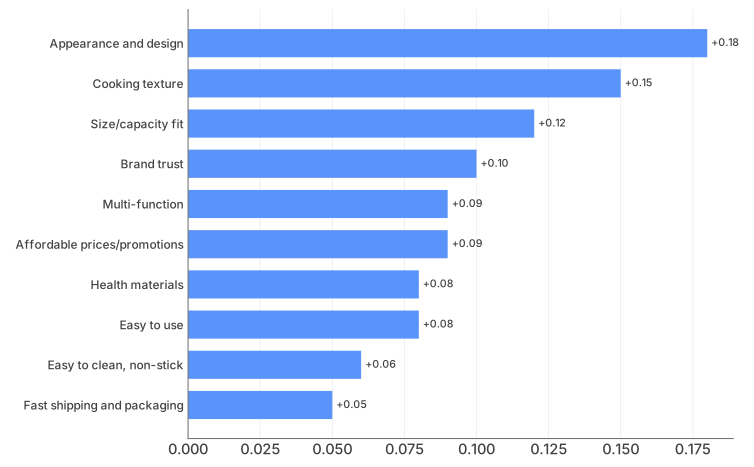
The most significant finding in the rice cooker category is a change in what drives purchases. Appearance and design overtook cooking texture as the leading purchase driver, at 18% against 15%, the first time that looks have ranked ahead of core cooking performance in this staple appliance.
Appearance value surpasses cooking texture as the top rice cooker purchase driver at 18%
Consumers Turn Away from Non-stick Coatings#
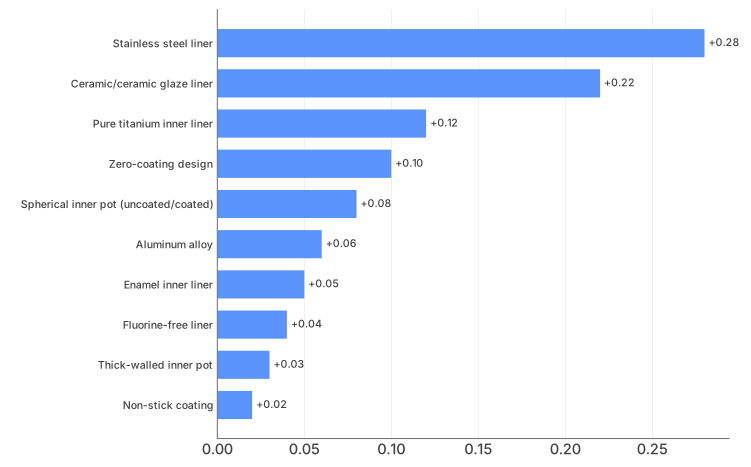
The clearest change in consumer preference concerns the material of the inner pot. Traditional non-stick coating accounts for only 2% of material preferences, the lowest share of any material option, as consumers move firmly toward materials they consider healthier, led by stainless steel and ceramic liners. Brands such as Combach have built their positioning on these health materials.
Traditional non-stick coating collapses to 2% as stainless steel (28%) and ceramic (22%) dominate
Emerging Feature Demands#
Beyond materials, consumers are asking for new features that show where innovation in the category is heading:
- Sugar-reducing rice mode: 8% feature preference, from health-conscious consumers and those managing dietary conditions
- Multi-grain selection: 7% preference, from urban consumers who want precise control over different varieties of rice
- Reservation timing: 11% preference, from busy working professionals who schedule cooking overnight
We believe these features show the rice cooker moving toward built-in intelligence that sits behind a simple one-button interface, so that added capabilities do not make the appliance harder to use.
Key Takeaways#
- Rice cookers reached CN¥ 9.23 billion but grew only 1.3%, as the fall in ASP points to a mature market with little revenue growth
- Demand is dividing between value brands such as Hemisphere, which enter at lower price points, and premium brands such as Tiger and Panasonic, which launch high-specification models
- Appearance and design overtook cooking texture as the leading purchase driver (18% against 15%) for the first time
- Traditional non-stick coating accounts for only 2% of material preferences, while stainless steel (28%) and ceramic (22%) liners lead preferences
- Brands such as Combach show that a positioning built on health materials can appeal to consumers
More from This Report#
About the Data#
This analysis draws on Moojing Market Intelligence data covering MAT 2025 (July 2024 to June 2025). Moojing analyses brand and category performance across major Chinese e-commerce platforms. For full methodology and additional insights, see the complete Kitchen Appliances & Cookware whitepaper.
This content adheres to Moojing's editorial standards .


