Cookware Booms +24.6% as Health Materials Rise
 By Jotham Lim
4 min read
By Jotham Lim
4 min read
Executive Summary#
China's cookware market grew faster than any of the other kitchen categories in our study, reaching CN¥ 22.19 billion (+24.6% YoY) while volume rose 42.3% to 210 million units[1]. Brand concentration in cookware is low, which allows newer brands with innovative products to enter quickly. The category is also shaped by a "healthy non-stick paradox", in which consumers want non-stick performance and coating-free materials at the same time, and we believe brands which can resolve this tension have a large opportunity in front of them.
Download Full Report#
Get the complete analysis with additional data, methodology details, and brand-level insights across all four kitchen appliance categories.
Download the Full Kitchen Appliances & Cookware Whitepaper ->
Growth in Both Volume and Value#
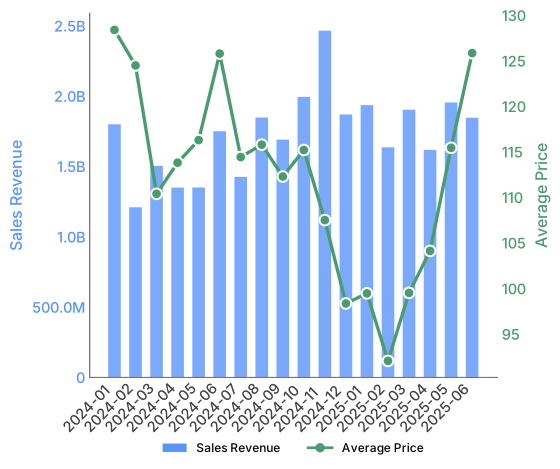
Cookware is the only kitchen category in which both volume and value grew by more than 20%. Its growth comes from new household formation and replacement demand, and also from the category's expansion into newer uses such as outdoor camping. Revenue peaked at CN¥ 2.47 billion in November 2024 on Double 11 promotional activity, while even the lowest months exceeded CN¥ 1.2 billion.
Cookware revenue peaks at CN¥ 2.47 billion in November 2024, driven by Double 11
A Fragmented Market Open to New Brands#
Brand concentration in cookware is markedly lower than in the other kitchen appliance categories we studied, which reflects low barriers to entry and the large part that product-specific differentiation plays in how consumers choose. We believe this leaves room for newer brands that build their offer around a clear product innovation, while international brands such as J.A. Henckels add a premium tier to the category, which shows that some consumers will pay for heritage quality.
The Healthy Non-stick Paradox#
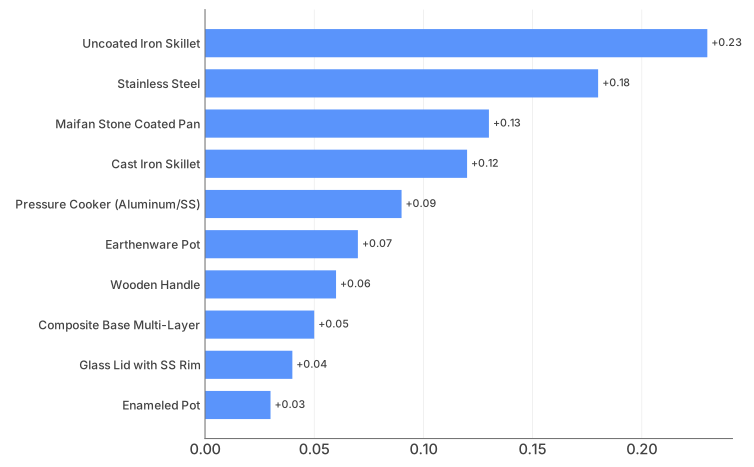
The most important finding in the cookware category is a tension between two things consumers want. Non-stick performance is the primary purchase driver at 21%, which makes it the baseline requirement, yet uncoated iron skillets lead material preferences at 23%.
Uncoated iron skillets lead material preferences at 23%, reflecting health-conscious trends
Sub-segment Growth#
Growth differs across the cookware sub-segments, depending on how each fits changes in cooking habits and lifestyles:
- Pot sets: grew 95.2%, driven by novice cooks and families looking for a complete set of cookware
- Pressure cookers and steamers: each grew about 50%, reflecting demand for "nutrient retention" and "fast cooking" as healthy eating spreads
- Frying pans: grew 31.4%, as Western cooking habits become more common
- Milk pans: grew 36.1%, driven by single-person breakfasts
- Chinese woks: remained the largest sub-segment at about CN¥ 10 billion, growing 14.1% with an ASP of CN¥ 147
Key Takeaways#
- Cookware reached CN¥ 22.19 billion (+24.6% YoY) with volume growth of 42.3%, the fastest growth of the kitchen categories in our study
- Low brand concentration leaves room for newer brands that compete on product innovation
- Non-stick is the main purchase driver (21%), yet uncoated iron leads material preferences (23%), which creates a "healthy non-stick paradox"
- Pot sets grew 95.2% as novice cooks and families look for complete cookware sets
- International brands such as J.A. Henckels add a premium tier, which shows that some consumers will pay for heritage quality
More from This Report#
About the Data#
This analysis draws on Moojing Market Intelligence data covering MAT 2025 (July 2024 to June 2025). Moojing analyses brand and category performance across major Chinese e-commerce platforms. For full methodology and additional insights, see the complete Kitchen Appliances & Cookware whitepaper.
This content adheres to Moojing's editorial standards .


