Southeast Asia Beauty E-commerce: $4.33 Billion Across Three Diverging Markets
 By Quan Wenjun
6 min read
By Quan Wenjun
6 min read
Executive Summary#
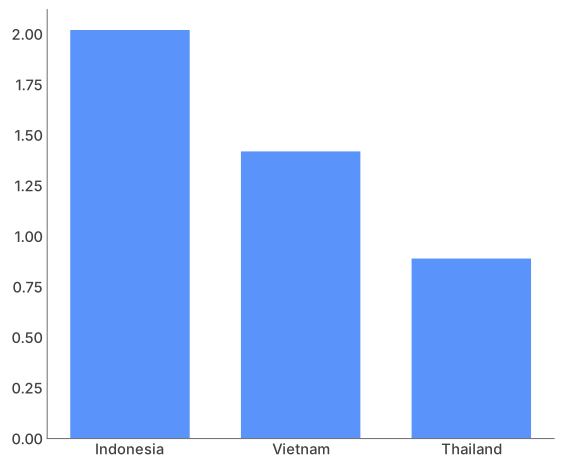
Southeast Asia's beauty e-commerce market on a leading regional marketplace reached $4.33 billion in combined beauty-only GMV across Indonesia, Thailand, and Vietnam over the trailing 12 months (April 2025 -- March 2026). Indonesia leads at $2.02 billion, followed by Vietnam at $1.42 billion and Thailand at $0.89 billion. But the aggregate figure masks three fundamentally different markets: Thailand's hair care is surging at +68% YoY, Vietnam's beauty tools segment stands alone at $612 million -- a category structure found nowhere else in the region -- and Indonesia's fragrance market reaches $401 million, the region's largest by a wide margin. Hair care is the only sub-category growing 20%+ in all three countries.
Download Full Report#
Get the complete analysis with brand-level insights, price segmentation, skincare deep-dive, and cross-market entry strategies.
Three Markets, One Region#
Indonesia's 278 million population makes it the largest beauty market by volume, with 42% under 25 -- one of the world's youngest beauty consumer bases. Its broader Beauty & Personal Care (B&PC) category totals $9.9 billion. Yet despite having only one-quarter of Indonesia's population, Thailand's beauty-only market is nearly equal in size. Thai per-capita beauty spending runs four times higher than Indonesia's, reflecting fundamentally different consumer economics.
Vietnam's market size data is inconsistent across third-party sources, but growth is the fastest of the three. With 35% of its population under 25 and social media usage at 73%, Vietnam is the region's most dynamic digital beauty market.
Key macro indicators across the three countries:
- Indonesia: 278M population, median age 30.2, 73% smartphone penetration
- Thailand: 72M population, median age 40.1, 83% smartphone penetration, 79% social media usage (highest)
- Vietnam: 100M population, median age 32.5, 71% smartphone penetration
Content Commerce Reshapes Discovery#
Content commerce already accounts for 32% of total SEA e-commerce GMV (Momentum Works, 2025). A McKinsey survey found 63% of consumers believe premium products are not more effective than mass-market alternatives. Local and regional brands now hold over 50% of FMCG share across the region (Bain). These trends create conditions where brand discovery happens through content, not shelf placement.
Beauty GMV: $4.33 Billion Across Three Markets#
Combined beauty-only GMV totals $4.33 billion. Indonesia contributes nearly half at $2.02 billion. Vietnam's beauty-only share of its broader B&PC category is just 53%, well below Indonesia's 67% -- not because beauty is small, but because Vietnam's "Beauty Tools & Accessories" ($612 million) stands as a major standalone category.
Indonesia dominates regional beauty GMV at $2.02 billion
Indonesia: Skincare Leads at $826 Million#
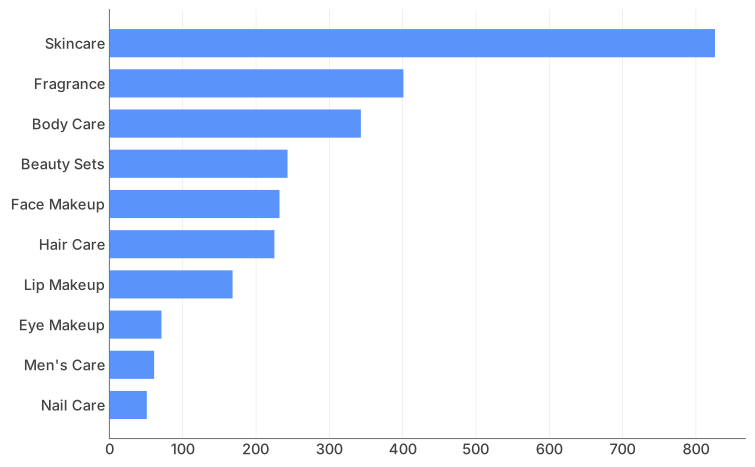
Skincare is Indonesia's largest beauty sub-category at $826 million (28.0%). Fragrance is the next data point of note: at $401 million, it is the largest fragrance market in the region by far.
Hair care is the growth story at $225 million and +23.8% YoY. Lip makeup (+11.3%) and nail care (+15.3%) show healthy momentum. Men's care, while small at $61 million, is growing at +21.9%.
Indonesia — skincare leads at 28% of beauty GMV
Thailand: Hair Care Surges +68%#
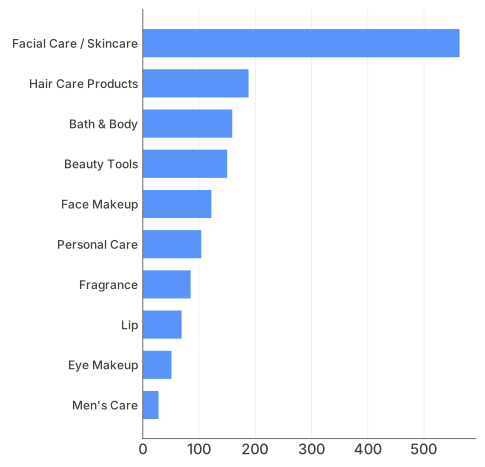
Thailand's beauty market tells a different story. Facial care/skincare leads at $563 million with steady +9.8% growth, but the breakout category is hair care at $188 million and +68% YoY -- the highest growth rate for any major sub-category in the three markets analysed.
Bath & body ($159 million, +12.6%), beauty tools ($150 million), and fragrance ($85 million, +17.3%) round out a balanced market. Men's care maintains +20.4% growth, consistent with the regional trend.
Thailand — hair care surges +68%, facial care dominates at 36%
Vietnam: Beauty Tools at $612 Million#
Vietnam's sub-category structure is unique in the region. Skincare leads at $798 million (+9.6%), but Beauty Tools & Accessories at $612 million (22.7%) is a category that simply does not exist at this scale in Indonesia or Thailand. Makeup ($422 million, +12.4%) shows strong momentum. Hair care grows at +21.1%, and women's care (+24.4%) and beauty sets (+22.6%) are both accelerating.
The Cross-Market Winners#
Against this backdrop of diverging category performance, two sub-categories stand out as universal growth stories.
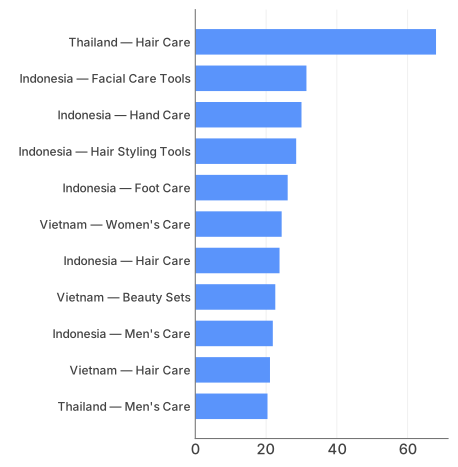
Hair care is the only category achieving 20%+ growth in all three markets. Thailand leads at +68% ($188 million), Indonesia at +24% ($225 million), and Vietnam at +21% ($221 million). Combined hair care across the three markets totals over $634 million.
Men's care is growing 20%+ in Indonesia (+21.9%) and Thailand (+20.4%), while Vietnam's men's care segment was flat at -0.1% YoY. Absolute revenue remains small ($61 million, $28 million, and $56 million respectively), but the Indonesia and Thailand trajectory signals early-stage male beauty adoption across much of the region.
Hair care is the only category growing 20%+ in all three markets
Key Takeaways#
- Combined beauty-only GMV across Indonesia, Thailand, and Vietnam totals $4.33 billion
- Indonesia dominates by volume ($2.02B) but Thailand's per-capita spending is 4x higher
- Content commerce accounts for 32% of SEA e-commerce GMV -- brand discovery is shifting to social channels
- Skincare is the largest sub-category everywhere (28--36%), but category structures diverge sharply below the surface
- Indonesia is the region's largest fragrance market at $401 million
- Vietnam's "Beauty Tools & Accessories" at $612 million (22.7%) has no equivalent at this scale in Indonesia or Thailand
- Hair care is the only sub-category growing 20%+ in all three markets -- the clearest cross-market opportunity
- Men's care grows 20%+ in Indonesia and Thailand, signaling early-stage male beauty adoption
- Active beauty brands in the dataset analysed: Indonesia 10,991 * Thailand 6,491 * Vietnam 7,375
About the Data#
This analysis draws on Moojing CMI statistics for Indonesia, Thailand, and Vietnam covering the trailing 12-month period (April 2025 -- March 2026). The e-commerce data covers one major marketplace in each of the three countries; it is not a whole-market census and does not cover every platform selling beauty in the region. Macro market sizing references third-party industry reports including Statista, Euromonitor, Momentum Works, Bain, and McKinsey. CMI figures reflect displayed transaction data (GMV inclusive of pre-refund and cancellation figures) and do not equal total market size. For full methodology and additional insights, see the complete SEA Beauty E-commerce 2026 whitepaper.
This content adheres to Moojing's editorial standards .
Frequently Asked Questions
Combined beauty-only GMV across Indonesia, Thailand and Vietnam reached $4.33 billion on the region's leading marketplace over the trailing twelve months to March 2026. Indonesia leads at $2.02 billion, Vietnam follows at $1.42 billion and Thailand at $0.89 billion. The aggregate is misleading on its own, though — these are three fundamentally different markets and their sub-category structures diverge sharply below the surface. Thailand's beauty market is nearly the size of Indonesia's on a quarter of the population, because Thai per-capita beauty spending runs about four times higher.
Indonesia is the volume market: 278 million people, 42% under 25, median age 30.2 and 73% smartphone penetration, with a broader beauty and personal care category worth $9.9 billion. Thailand is the value market: 72 million people, median age 40.1, 83% smartphone penetration and the region's highest social media usage at 79%. Vietnam is the fastest-growing and most digitally dynamic: 100 million people, 35% under 25, median age 32.5 and social media usage at 73%. Those profiles predict the category mixes — a young, large, price-sensitive base behaves differently from a smaller, older, higher-spending one.
Hair care is the only sub-category growing above 20% in all three markets — Thailand at +68% ($188 million), Indonesia at +24% ($225 million) and Vietnam at +21% ($221 million), more than $634 million combined. Men's care grows above 20% in Indonesia (+21.9%) and Thailand (+20.4%) from small absolute bases, though Vietnam's moved -0.1%. Going the other way, fragrance is cooling regionally: Indonesia's, the largest in the region at $401 million, moved -35.4%, and Vietnam's -17.5%. Skincare remains the largest sub-category everywhere at 28% to 36% of each market, but its growth has flattened in Indonesia at -1.3%.
A beauty tools and accessories category worth $612 million — 22.7% of its beauty market, and a structure that does not exist at that scale in Indonesia or Thailand. It is why Vietnam's beauty-only share of its broader personal care category is 53% against Indonesia's 67%: not because beauty is small there, but because a whole standalone category sits alongside it. Skincare still leads at $798 million (+9.6%) and makeup shows momentum at $422 million (+12.4%), with women's care (+24.4%) and beauty sets (+22.6%) both accelerating. Vietnam is also where social commerce moved fastest, one platform going from 28% to 42% share in a single year.


